
LinkedIn Is Changing How People Discover Your Content. Here’s Why Insurance Agencies Should Care.
For years, building an audience on LinkedIn meant building connections. That’s still important, but LinkedIn’s latest changes could make what you know just as important as who you know.
If you’re an independent insurance agency owner, your LinkedIn network probably includes other agents, carrier representatives, wholesalers, local business owners, and a few people you haven’t spoken to in twenty years.
Those connections have traditionally been your primary audience when you publish something. If they engage with your post, it might reach their connections, too. But LinkedIn is getting considerably better at identifying people who might find your content valuable, even if they’ve never heard of you.
That creates an interesting possibility for independent insurance agencies.
How LinkedIn’s Algorithm Now Matches Content to Readers
In November 2026, LinkedIn’s engineering team published an explanation of its improved content recommendation system, called Profile Relevance.
The system uses artificial intelligence to understand the professional interests of LinkedIn members and match them with relevant content from outside their existing networks.
It considers information such as industry, job titles, professional experience, skills, and geographic location. It also analyzes the subjects being discussed in individual posts.
The goal is to recommend content based on professional relevance, not simply the number of connections someone has.
LinkedIn reported that its new system reduced the rate at which users hide recommended posts by 18.8% in its experiments.
These improvements are encouraging news for professionals whose expertise may be considerably greater than the size of their LinkedIn networks.
Why This Matters for Independent Insurance Agencies
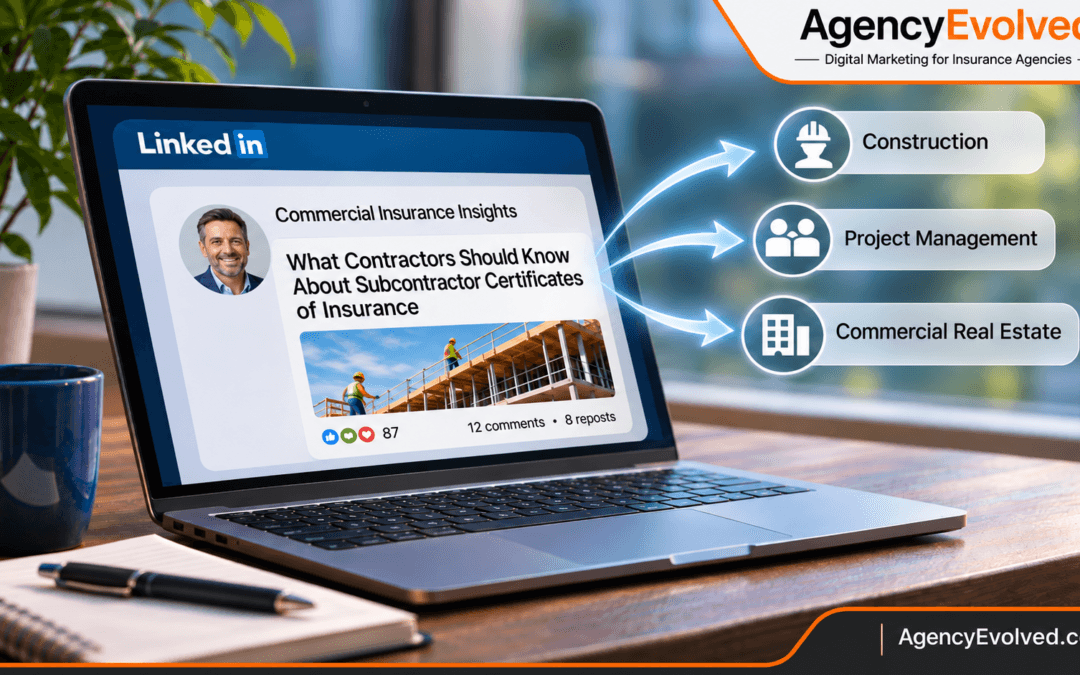
Consider an agency owner who specializes in commercial insurance for contractors.
She publishes a post discussing a common problem with subcontractor certificates of insurance, explaining what general contractors should look for and why it matters.
Under LinkedIn’s improved recommendation system, that post may be relevant to construction company owners, project managers, and other professionals who deal with subcontractor insurance requirements.
Some of those people might not be connected to the agency owner or even know her agency exists. But the subject matter of the post aligns with their professional interests.
That’s a meaningful opportunity for an agency to reach prospective clients.
The same principle could apply to agencies specializing in trucking, manufacturing, hospitality, professional liability, or virtually any other commercial insurance market.
Instead of trying to reach everyone, create content that’s genuinely useful to the people you want to reach.
Your Personal LinkedIn Profile Still Matters
When LinkedIn shows your post to someone outside your network, the match is based largely on what your post is about and what that reader does professionally.
LinkedIn’s system also considers certain information about the author, including geographic location. But LinkedIn doesn’t indicate that adding more credentials to your profile will automatically increase your posts’ reach.
However, if someone finds your post interesting, one of the next things they may do is click your name.
That makes a complete, accurate professional profile worth the effort. It’s what helps turn a stranger who found one useful post into someone who sees you as a credible resource.
An agency principal with twenty years of commercial insurance experience should make that expertise visible. So should a producer who has spent a decade working with construction accounts.
Your agency’s company page still serves an important purpose. It provides an official business presence, supports brand recognition, and gives employees and clients a place to connect with the organization. But company pages shouldn’t be an agency’s entire LinkedIn strategy.
Agency owners and producers have something a company page cannot fully replicate: their individual experience, relationships, and professional perspectives.
A thoughtful post from a producer explaining something learned during a recent renewal can be more interesting than a generic company post reminding everyone to review their insurance coverage.
The distinction isn’t necessarily how polished the content looks. It’s whether the person reading it finds something useful.
Generic Insurance Posts May Have an Even Harder Time
We’ve all seen them. A stock photo of a smiling family accompanied by a reminder that life is unpredictable. A picture of a house encouraging homeowners to review their policies. Or another variation of “Five Reasons You Need Insurance.”
There’s nothing inherently wrong with reminding people about insurance. But those posts rarely demonstrate what makes one agency different from another.
LinkedIn’s research specifically found that its improved recommendation system reduced generic content among its recommendations.
That doesn’t mean generic insurance posts will disappear or that LinkedIn automatically penalizes every piece of general-interest content. It does suggest that agencies have another reason to move beyond interchangeable social media content.
A producer discussing changes in the local construction market has something specific to contribute. An agency owner explaining why commercial property renewals have become challenging can provide a useful perspective.
An employee sharing an observation about helping a business recover from a claim can demonstrate the agency’s expertise and commitment to its clients, provided client confidentiality is respected.
These are the conversations that help people understand what your agency actually knows.
What Should Your Agency Do Differently?
The good news is that you don’t need to become a social media expert or start posting five times a day. A few practical steps can put your agency in a better position.
1. Make sure your professional profiles tell the right story.
Agency owners and producers should have current LinkedIn profiles that accurately describe their experience, specialties, and markets served. Think of your profile as the place where someone can learn more after discovering your content.
2. Talk about the insurance issues you actually work with.
If your agency specializes in contractors, discuss contractors’ insurance concerns. If you work with restaurants, share observations about the risks restaurant owners face. Use your real expertise rather than looking for something generic to publish.
3. Encourage agency leadership to participate personally.
Your company page is important, but it shouldn’t be the only voice representing the agency. Owners and producers can contribute perspectives that make the business more approachable and credible.
4. Engage in relevant professional conversations.
Comment on posts from clients, local businesses, industry associations, and other professionals when you have something meaningful to contribute. Don’t treat engagement as a numbers game. Treat it as relationship building.
5. Focus on consistency, not volume.
One useful post a week is a perfectly reasonable starting point. Build a routine your team can maintain without taking attention away from serving clients.
Better Discovery Doesn’t Guarantee More Views
It’s important to keep expectations realistic. LinkedIn hasn’t promised that every informative post will reach thousands of people. Connections, engagement, and other signals still influence what appears in users’ feeds.
In fact, LinkedIn’s engineering team explained that a post must receive at least one like, comment, or share from someone outside the author’s network before it qualifies for recommendations through this particular system.
That’s an important reminder that relevance alone isn’t enough. People still need to find your content worth engaging with. The new system isn’t a shortcut around building relationships and participating in professional conversations.
What has changed is LinkedIn’s ability to recognize when your expertise might be useful to someone who doesn’t already know you.
Your Expertise Is Your Advantage
Independent insurance agencies sometimes struggle to compete with the marketing budgets and brand recognition of larger organizations. But they have an advantage that’s difficult to manufacture: firsthand experience working with clients, understanding local businesses, and solving insurance problems.
LinkedIn’s improved content recommendations may make it easier for that expertise to reach people beyond an agency’s immediate network.
You don’t need to become an influencer.
You need to demonstrate why someone should trust you with their insurance business.
And that’s something a good independent insurance agency already knows how to do.
Source: LinkedIn Engineering: Profile Relevance: Boosting Feed Relevance with LLMs at LinkedIn, November 9, 2026.
About AgencyEvolved
AgencyEvolved provides personalized marketing and consulting services for independent insurance agencies, brokers, wholesalers, and other insurance organizations.
Founded by an insurance industry veteran with more than 40 years of experience, AgencyEvolved combines practical insurance knowledge with thoughtful marketing strategy. We help clients strengthen their brands, communicate what makes them different, and build lasting relationships with the customers and communities they serve.
We work with a limited number of clients, providing hands-on attention and customized solutions rather than standardized marketing packages.
Our services include website design and management, content creation, social media, email marketing, digital advertising, branding, and strategic marketing consulting.
Marketing built around your business. Not the other way around.